
Why Emotional Honesty Matters in the Workplace
Emotional honesty in leadership doesn’t start with dramatic conversations. It starts with something much smaller. In my workshops, I often open with a simple question: “Give me one feeling word for how you’re arriving today.” I want to know how people are showing up. I also use a similar question at the end to check in, which helps me gauge movement.
There was a time when I avoided bringing emotion into the room. Not because I didn’t believe emotions mattered. I just wasn’t sure I could hold them in a field that tends to avoid them. I was reflective and comfortable analyzing stress or conflict, but I wasn’t precise about emotion and wasn’t fully comfortable when it surfaced in real time.
So, I began gently. One workshop began with a one-word emotional check-in, which we repeated at the end to notice what had shifted. A stress session on the internal judge required participants to name the emotion beneath their self-criticism before analyzing the pattern. And in breakout conversations, we practiced a simple sentence stem: “When you say that, I feel…”
None of this was intended to create drama or to bring in work therapy. I knew we had to start building emotional capacity. I realized that if we want honest conversations in the workplace, we must increase our tolerance for emotion.
The Personal Work Behind Emotional Inclusion
The deeper truth is that my work on emotional inclusion didn’t stem from official training, even though I have attended sessions on Emotional Intelligence. As I studied more, I realized it started in my family.
I grew up in an environment where certain emotions were unwelcome. Difficult feelings, such as sadness, fear, or hurt, were uncomfortable and often dismissed. Anger, though, was permitted—at least for my brothers and Dad. That was considered a strength. For my mom and me, emotion was riskier. It could be labeled dramatic, excessive, or too sensitive.
So, I learned what many of us learn in leadership cultures: contain it. Always stay steady and never make waves.
When I later learned about my Adlerian Number One Priority, fear of rejection, it helped me understand why certain moments activated me so intensely. I began noticing a line of heat just above my heart whenever I felt dismissed or exposed. Sometimes it was shame, and sometimes anxiety. I noticed how much that fear held me back.
For years, I tried to think my way through those reactions. But emotional honesty began when I stopped arguing with my body.
Around that time, I was introduced to the Gottman Feelings Wheel. I realized how few emotion words I used. “Frustrated.” “Overwhelmed.” “Fine.” They were broad and socially acceptable, yet vague. Frustration sometimes masked resentment. Overwhelm sometimes hid grief. “Fine” often concealed disappointment.
So, I began practicing deeper precision, one emotion at a time. I paid attention to what irritation felt like versus anger, how shame differed from guilt, and when anxiety shifted into dread. Emotional honesty wasn’t dramatic; it was disciplined.
Emotional Inclusion in Conservation Leadership
As my work expanded into ecogrief workshops and high-profile conservation teams, I realized that inviting emotion wasn’t optional; it was required. When coral reefs bleach, species decline, or public hostility surrounds wildlife decisions, you cannot intellectualize your way through it. You cannot bypass grief. If we want honest conversations about conservation loss, we must allow the emotion that accompanies it.
In one group doing high-profile conservation work, I invited emotions in a significant way. We named fear, frustration, pride, and fatigue. Years later, the leader told me they still talk about that workshop because they now check in on each other differently. There is more bonding, honesty, and care. Emotional inclusion did not destabilize the team. It strengthened them.
And yet, I know how risky emotional honesty can feel. I have been called “too much” in moments that were entirely human, like learning that someone I trusted had spread a rumor about me. Shock, grief, and anger are not tidy emotions. I have been labeled a troublemaker for raising concerns about a project being undermined. The message in those moments was clear: don’t bring hard emotions upward. Manage them on your own.
When leaders cannot tolerate difficult emotions, they train others to bury them.
Honest Conversations Require Emotional Capacity
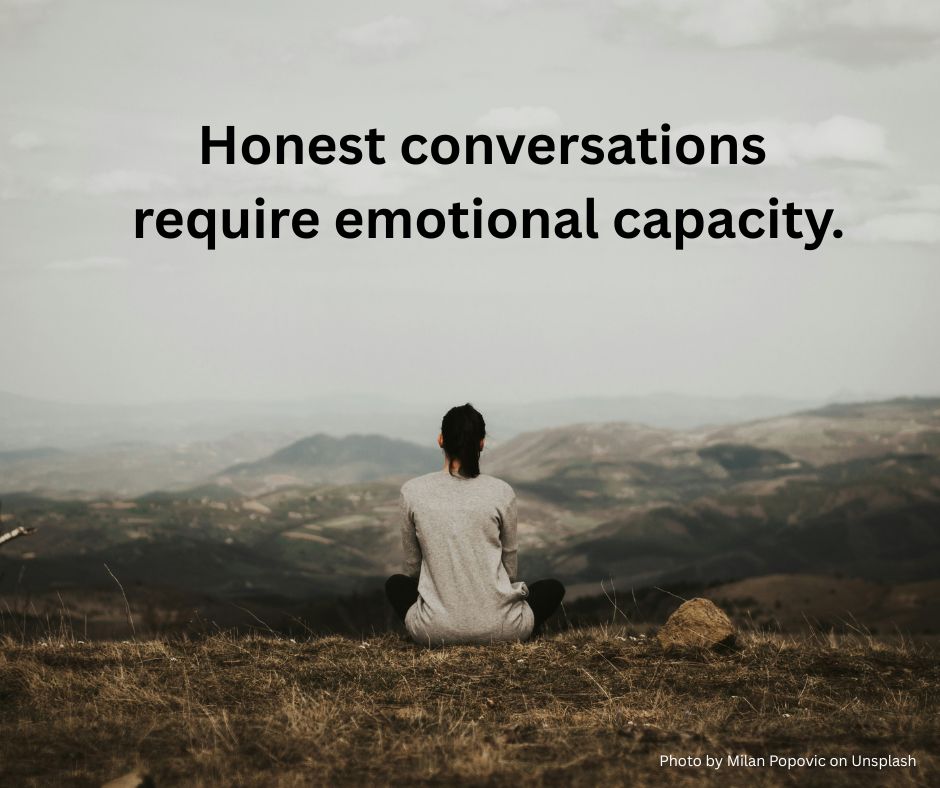
Last summer, a survey of conservation professionals found that 44% of respondents wanted more honest conversations about hard topics, including ecogrief. We say we want honesty in leadership; transparency, vulnerability, and real dialogue. But honest conversations require emotional honesty, too. And emotional honesty requires emotional capacity.
We often confuse emotional control with leadership strength. We assume that steady means unaffected, that being professional means detached, and that being objective means being emotionless. But emotional control without emotional honesty is suppression, and suppression doesn’t eliminate emotion. It drives emotion underground, where it shows up as burnout, resentment, sarcasm, or quiet disengagement.
If nearly half of leaders are asking for more honest conversations, the issue is not just communication training. It’s emotional tolerance.
The Gender Double Standard Around Emotional Honesty
Workplaces do not treat emotional honesty equally. Colleagues often interpret visible emotion in men, especially fear or sadness, as a sign of weakness. They frequently label women’s emotions as instability or excess. When women of color express direct emotion, others often perceive it as aggression.
The result is predictable: people self-censor. They soften their words and mask their reactions. They edit themselves to survive.
When emotional honesty is punished differently depending on who expresses it, emotional inclusion must be intentional. Otherwise, calls for “honest conversations” become hollow.
How to Build Emotional Capacity in Leadership
Emotional capacity is not a personality trait; it’s a practice. And like any leadership discipline, it grows with repetition. Here is what that has looked like in my own work and in the teams I facilitate.
1. Expand Your Emotional Vocabulary
The primary emotions are mad, sad, glad, scared, peaceful, and powerful, and many of us stick to those core concepts. But precision matters. Sad could be bored or inadequate. Scared could mean confused or insecure. Mad could mean frustration or even jealousy.
When I began studying the Gottman Feelings Wheel, I focused on one emotion at a time and paid attention to when it surfaced. I noticed that shame felt different from guilt, that anxiety felt different from dread, and that irritation carried a different charge than anger.
Honesty begins with accuracy. If you cannot name what you are feeling, you cannot speak honestly about it.
2. Practice Relational Ownership
In my workshops, we use a simple sentence stem: “When you say that, I feel…” It sounds basic, but it is not. This practice shifts the conversation from accusation to impact. It fosters ownership and slows reactivity. It builds emotional honesty without weaponizing emotion.
There is a difference between “You’re being dismissive” and “When you said that, I felt dismissed.” One escalates, while the other informs. Honest conversations require this discipline.
3. Notice Where Emotion Lives in Your Body
For me, fear of rejection shows up as heat along a line just above my heart. I didn’t discover that through theory. I discovered it by paying attention.
Emotion ignored becomes projection. Emotion noticed becomes information.
When you feel activated, ask:
- Where is this in my body?
What is it asking for?
What is underneath it?
This is not indulgence. It is regulation.
4. Create Micro-Safety in Teams
You do not need dramatic interventions to build emotional inclusion. Start meetings with one feeling word. End with one word describing what shifted.
Require naming emotions before analyzing behavior in stress conversations. Normalize emotional data without turning every meeting into processing. Capacity grows slowly, and safety grows incrementally.
Emotional Inclusion Is Leadership Stamina
If we want honest conversations about burnout, conflict, funding uncertainty, or conservation loss, we must increase our tolerance for the emotions that accompany these realities. Last summer, when 44% of respondents told me they wanted more honest conversations about hard things, it was not a request for better scripts. It was a request for deeper emotional capacity.
That is why I created an Emotional Inclusion workshop. Over the years, I have drawn on what I have learned personally, from family conditioning to Adlerian insights to the Gottman wheel to ecogrief facilitation, and built a structured, gentle pathway for leaders and teams. The goal is to build emotional capacity, the ability to notice, name, and work with emotion as information without collapsing or attacking.
Emotional inclusion is not soft. It is leadership stamina. If nearly half of leaders are seeking honest conversations, the invitation is clear. We do not need less emotion. We need a stronger capacity to hold it.
Honesty is the accurate naming of emotions, and that is what builds trust.
Ready to build honest conversations?
If you’re reading this and thinking, “Yes… but that sounds uncomfortable,” you’re not wrong. Building emotional capacity stretches us. But it’s not scary, and it’s definitely not an emotional free-for-all.
The Emotional Inclusion workshop is designed to bring people in gently — expanding tolerance without overwhelming anyone. I promise not to throw you into the deep end. We build this skill step by step, together. If you’d like more information, please reach out to me at michelle@anavahconsulting.com. I’d love to support your team.