
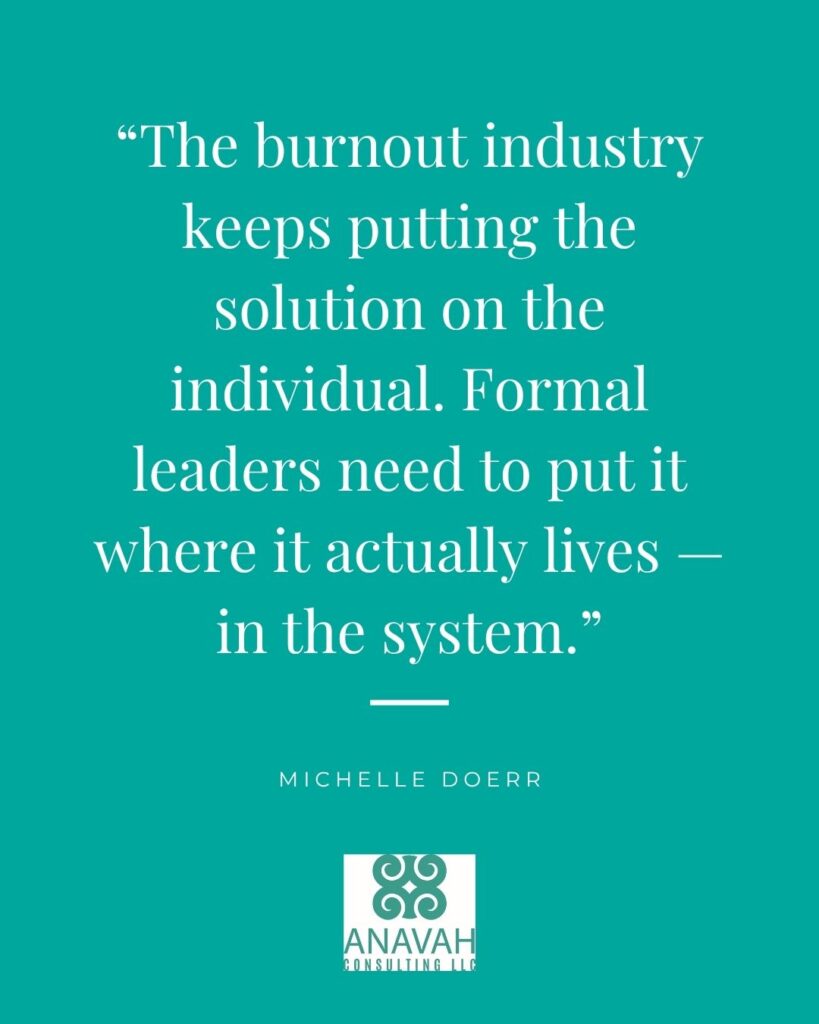
Capacity building for leaders in mission-driven organizations is not a perk or an afterthought. It is a design responsibility. Here’s why I had to learn that the hard way.
So, I have a confession to make.
For several years, I led self-care workshops. I talked about burnout in the way the burnout industry taught me, by focusing on symptoms to watch for, strategies to manage, and individual practices to build resilience. Check your attitude. Find the quiet. Remember your why. Get outside. The underlying message, even if I didn’t intend it, was: this is how you survive what we are not going to change.
I was part of the problem.
I started noticing the cracks when I came across the term “imposter systems” in Jenny Vasquez-Newsum’s Untapped Leadership and traced it to ‘Tine Zekis, who I believe coined it. That single shift — from syndrome to system — changed everything. Imposter syndrome describes an individual’s lack of self-belief, while imposter systems refer to how organizations foster that feeling, whether intentionally or negligently, and then pass the blame back to the individual to handle.
Then came the executive order that removed certain language from federal use. Resilience was on the list. Instead of simply swapping the word and moving on, I sat with it. What was resilience actually doing in practice? I discovered that most of the time, resilience meant becoming better at surviving conditions we had no plans to change. Endurance disguised itself as strength.
I didn’t want to build that anymore.
Earlier this year, I wrote about these themes in The Wildlife Professional and shared my thoughts on them in my LinkedIn newsletter. This blog goes further — specifically targeting the formal leaders who shape the conditions everyone else works in.
What the Data Says About Burnout in Conservation
Since my 2021 article in The Wildlife Professional — where, honestly, I still assign most of the responsibility to the individual — I’ve been collecting real-time data from hundreds of wildlife and conservation professionals across the country. What I keep hearing is that the issue goes beyond burnout.
In a recent live audience, 58% reported feeling overwhelmed or stretched too thin. Another 57% said they were burned out or emotionally drained. Only 20% said they felt motivated and energized.
But the number that stopped me cold wasn’t any of those. It was the people who, when asked whether they hear their teams talking about burnout, selected: “I get burned out talking about burnout.“
When I reviewed the rest of their data, the message was clear. These weren’t people who were tired of the conversation; they were people who had concluded that the organization already knew about the problem, didn’t care, and wasn’t going to do anything about it anyway. So why were we even talking about it?
That is not burnout; it’s disillusionment. Disillusionment occurs when people move beyond exhaustion into a quiet choice to do the minimum needed to get by. Some will leave, while many will stay and disappear in plain sight.
When more than three-quarters of your people report feeling burned out or overwhelmed, that reflects a system issue. It’s not an individual failure. Honestly, it would be dishonest to place that blame on the individual.
The Sustainable Workload Myth Formal Leaders Need to Drop
Here’s the sustainable workload myth I most want to name directly: that always-on equals more value. That the person who answers emails at 10 pm, skips lunch, carries three people’s work, and never says no is the one the organization can’t afford to lose.
This belief is costing you your top talent, and it’s costing the people who hold it something they can’t get back.
In my work with teams, I have seen this myth surface in subtler ways — especially around help and guilt. People stay overloaded not just because they want to seem indispensable, but because they truly believe no one else can do it, or that taking a step back means letting their colleagues down. What we found in one organizational engagement was that this belief was running in both directions: the over-functioning person didn’t trust that anyone below them could handle more, while the people beneath them were quietly eager to contribute at a higher level.
The honest conversation about workload and priorities — the one most teams are not having — is where that myth falls apart. And most teams aren’t having it, partly because most leaders don’t truly have clear priorities themselves. If you can’t identify your team’s top three priorities right now, without hesitation, that’s the first place to start.
Burnout Is a System Signal, Not an Individual Failure
In ecology, when a population crashes, we don’t blame the animals. We examine the habitat. We ask what has changed in the conditions — food supply, territory, corridor access, and carrying capacity. We view the population data as information about the system.
Burnout is the same kind of signal. When your people are overwhelmed, emotionally drained, and disengaged, that is habitat data. It shows you something about the conditions you have created—or failed to create—and formal leaders are responsible for shaping those conditions.
This isn’t about blame; it’s about accountability. The same dual responsibility I apply in all my work: individuals are accountable for their own growth and decisions, and systems are accountable for the conditions that influence those decisions. Neither responsibility negates the other. However, when three-quarters of your people are struggling, the system must first examine itself.
The shift I’m asking leaders to make is this: stop viewing capacity as something individuals handle in their own time, and start seeing it as something you build into the system before work begins. Capacity building happens beforehand, not afterward. It’s not about recovering from a tough season. It’s the design decision that determines whether the season breaks people or not.
My Winter 2026 Wildlife Professional article explains what this shift looks like in practice — moving from coping to capacity building, from individual self-care to structural design. The contrast is worth reflecting on.
Capacity Building for Leaders: What to Actually Do
This is where I want to be clear, because the gap between insight and action is where most leadership development fails.
Begin with an honest workload audit. Not a survey. Have a genuine conversation with each team member about what they are actually handling, the real priorities, and the gaps. If you haven’t had that talk lately, you don’t truly know what your people are managing.
Model the boundary; don’t just permit it. If you send emails at 10 pm, your team interprets that as an expectation regardless of what you say. Capacity norms are set by what leaders do, not what they declare. If you want people to protect their energy, they need to see you protecting yours.
Implement structured debriefs after tough events. Following challenging stakeholder meetings, legislative sessions, or contentious public hearings—anything that drains your team—schedule a brief debrief. Focus on what went well, what you’re grateful for, and what you can improve next time. The “what went wrong” approach is a waste of your limited energy. Instead, framing discussions positively helps build collective capacity without adding extra burden.
Make priorities explicit and visible. If everyone on your team can’t confidently name the top three priorities, you don’t actually have priorities — you just have a list. This confusion is a major cause of feeling overwhelmed, and you have the power to fix it.
Create space for genuine conversations. Not the check-in where everyone claims they’re fine. Instead, the one where it’s safe to admit that the workload isn’t sustainable, or you’re losing sight of why this work matters, or you need something to change. That kind of conversation requires you to have built enough trust and psychological safety so that people believe something will actually happen when they speak honestly.
The Reframe: Capacity Is a Leadership Responsibility
The burnout industry will continue to produce podcasts, workshops, and individual strategies. Some are helpful, but none are enough.
What conservation — and every mission-driven field — truly needs is for formal leaders to recognize that their people’s capacity is a design responsibility, not just a personal one. The conditions you create either strengthen people before tough seasons arrive or drain them until there’s nothing left to give.
You are always designing something. The question is whether you’re doing it on purpose.
This reframe is at the heart of the work I’ve been doing for the past several years — work that is finding its way into a book I’m finishing on leadership development in mission-driven systems. More on that soon.
In the meantime, if you’re ready to honestly evaluate what your system is producing and what it would take to create something different, I’d love to talk. Every organization’s situation is unique, and the most helpful thing I can do is listen first. Reach out at michelle@anavahconsulting.com, and let’s start the conversation.
Read my full arc on this topic: Tuning In to Burnout — The Wildlife Professional, January/February 2021 and Beyond Burnout: What Wildlife Professionals Are Really Asking For — The Wildlife Professional, Winter 2026. Reach out for copies.