
Why leadership capacity and human capacity are not the same thing
Conservation organizations typically evaluate leadership capacity by measuring performance, adaptability, and output. But leadership capacity and regenerative capacity are not the same thing. In mission-driven fields like conservation, high-performing leaders often experience burnout not because they lack skills, but because the internal conditions required to sustain those skills have been depleted. This piece names that distinction, introduces a framework for understanding it, and asks what changes when we take it seriously.
This isn’t just a language issue. “Capacity” in conservation often becomes a proxy for who can handle the most pressure under deadlines, supervisor expectations, and professional norms that reward over-functioning. Measuring output without considering the conditions that produce it protects the institution, not the people doing the work.
The Tension in the Room
I was sitting in a room working on the design of a conservation leadership program, reviewing the criteria for participant selection. The language used to describe ideal candidates included the word capacity. Capacity to lead change and to motivate others. Capacity to deliver results under pressure. And I felt the tension immediately. Because I had recently made a deliberate decision to use that same word to mean something else entirely.
For years, I had used words like “well-being ” and “resilience” to describe what I was most concerned about in conservation leadership culture. Then those words became politically complicated and were effectively banned in some professional contexts. Reviewing my language became necessary. And capacity rose to the surface. Not as a replacement for wellbeing, but as something sharper. Something that implied this work belongs on the front end of leadership development, not tucked away as optional self-care on personal time.
So there I was: a word I had carefully chosen, already occupied by a completely different meaning in the same room. That collision told me something important. We have a category error on our hands, and it is costing us.
The more I sat with that tension, the clearer the problem became. We have collapsed two fundamentally different realities into a single term. We use ‘capacity’ to describe both a person’s ability to perform and the human conditions required to sustain that performance over time, as if the two were interchangeable. They are not.
How the Field Uses “Capacity”
To be fair, the leadership development use of the word is not wrong. It is the dominant usage in organizational contexts, and it matters. When most conservation organizations talk about capacity, they mean something like this:
Demonstrated competency. Leadership readiness. The ability to motivate, deliver, and adapt. The potential to take on more. Leadership horsepower.
Organizations need to assess whether someone is ready to lead at a higher level. They need to evaluate skillset, judgment, and demonstrated ability. None of that is misguided.
But here is the problem: this definition is measuring skillset. And somewhere along the way, conservation leadership culture started calling skillset capacity as if they were the same thing. They are not.
Why Leadership Capacity and Human Capacity Are Different
Skillset is what a person can do. It is the accumulated competencies, learned behaviors, and demonstrated abilities that allow someone to function effectively in a leadership role. It is largely stable, buildable over time, and reasonably visible from the outside.
Regenerative capacity is something else. It is the quality and availability of a person’s internal energy for sustained, meaningful work. It is the emotional, relational, cognitive, and nervous system resources that determine whether someone can actually access their skillset and keep accessing it over time, under pressure, in conditions that are often far from ideal.
Here is what makes this a category error rather than a simple gap: you can have a full skillset and a depleted regenerative capacity at the same time. In fact, many of the highest-performing leaders in conservation are living proof of exactly this. They deliver, and they lead. They hold enormous organizational weight. And inside, they are running on empty.
When we measure skillset and call it capacity, we are measuring output. We are not measuring what is sustaining it. That distinction, invisible in the short term, becomes very visible eventually.
Measuring the Harvest, Not the Soil
Conservation already understands this problem. We understand it ecologically.
A conservation biologist would never assess ecosystem health by measuring output alone: harvest yield, board feet, fish counts, while ignoring regenerative indicators like soil health, biodiversity, recovery cycles, and habitat conditions. We would recognize that immediately as extractive management, not stewardship. Output without regeneration is not sustainable. It is depletion disguised as productivity.
Yet this is precisely what most conservation organizations are doing with their people.
They are measuring the harvest. They are not measuring the soil.
They assess who can deliver, who can lead change, and who can absorb more responsibility. They reward those who keep producing. And they largely do not ask what conditions are sustaining that output. What is being depleted in order to maintain it. Whether the system itself is creating conditions for regeneration, or quietly extracting it.
This is the same worldview that conservation exists to challenge. We just have not applied it to ourselves.
Introducing Regenerative Capacity
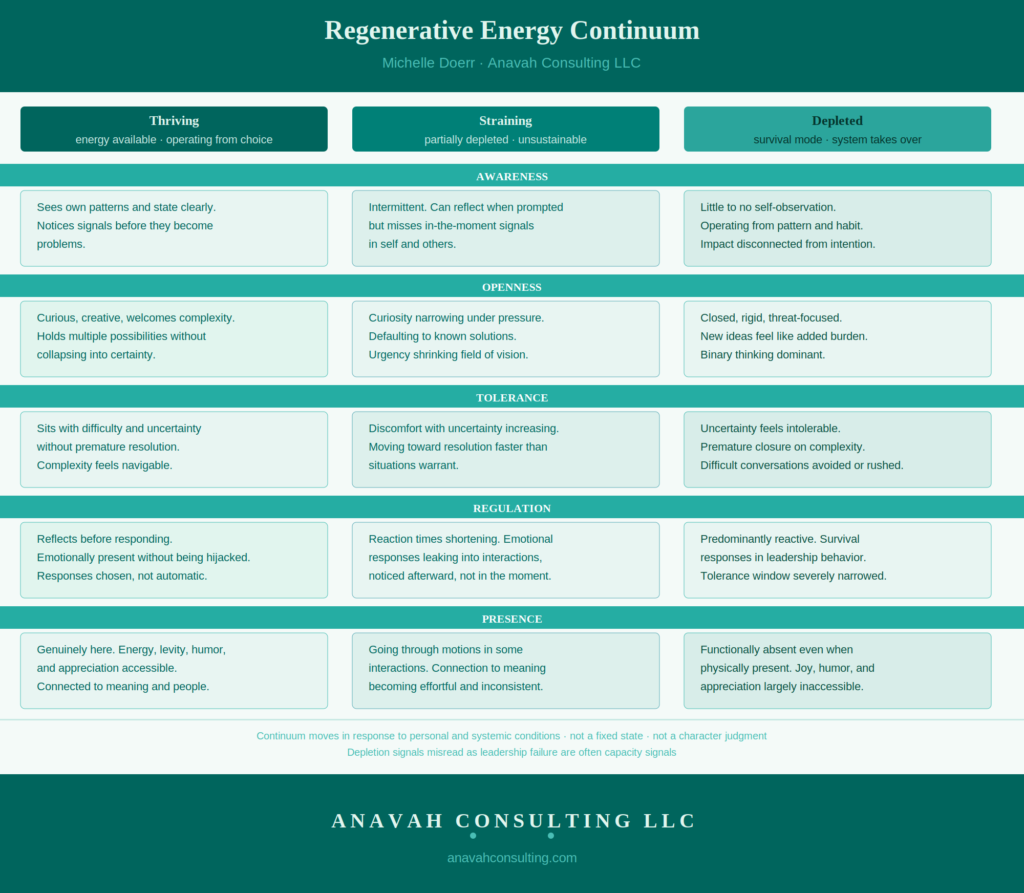
In my work with conservation and mission-driven leaders, I have come to understand regenerative capacity as something that does not hold still. It moves along a continuum in response to conditions, both personal and systemic, and it has five internal dimensions that deplete and restore together.
- Awareness: the ability to see your own patterns, triggers, and state clearly enough to make choices rather than simply react.
- Openness: access to curiosity, creativity, and the ability to hold complexity without collapsing into certainty or urgency.
- Tolerance: the capacity to sit with difficulty, ambiguity, and uncertainty without needing to resolve it prematurely.
- Regulation: the ability to reflect and respond rather than react, to be emotionally present without being emotionally hijacked.
- Presence: genuine relational availability, being actually here, connected to meaning, to people, and to purpose.
When these five dimensions are functioning well, what becomes visible is energy, levity, curiosity, humor, and appreciation. When they are depleted, what becomes visible looks like something else entirely, and that is where the misreading begins.
I call this the Regenerative Energy Continuum: a framework for understanding where a leader is operating, not as a fixed judgment but as a living read of conditions. It moves and responds. It is not a character assessment, but a capacity signal. This framework should never be used as a promotability score, a “culture fit” screen, or a reason to discipline someone. It’s a diagnostic tool for conditions and a prompt for resourcing, staffing, and boundary adjustments.
What Burnout and Capacity Depletion Actually Look Like
I was assigned to build an educational space at a major industry trade show. The project had been handed to me largely on my own, stacked on top of other active projects. I did what many mission-driven people do: I put my head down and made it work. By the time the show opened, what I had built was genuinely impressive. People noticed. By most measures, I was performing at the top of my game.
What nobody saw was that I had been getting sick for weeks before I arrived. I kept telling myself “just one more day” to push. And then another day. And another. My body was sending signals I had learned, very efficiently, to override.
By day three of the show, I was in my hotel room. I came home with pneumonia.
To everyone in that room, I had it all together. I appeared fully capable of continuing to do excellent work. That was the read from the outside, and by the dominant definition it was accurate. My skillset was fully intact. My regenerative capacity had been in critical depletion for weeks.
This is not an unusual story in conservation and mission-driven work. It is a nearly universal one.
When Depletion Shows Up as Behavior
What makes it organizationally significant is what happens when depletion shows up not as illness, but as behavior. Rigidity in meetings. Reactive decision-making. Shortened patience. Disengagement from people. Poor judgment on things that would normally be straightforward. These are the signals that most organizations respond to with performance management: feedback conversations, development plans, and increased oversight.
Research on the nervous system, specifically the concept of the window of tolerance, helps explain what is actually happening. When a person operates beyond their capacity for sustained stress, higher cognitive and reflective functions begin to go offline. Awareness narrows. Flexibility decreases. The very capabilities we associate with good leadership: nuance, empathy, strategic thinking, and emotional regulation, are precisely what become inaccessible under chronic depletion.
Applying performance management to that state does not address the actual problem. It adds pressure to a system already beyond its load-bearing capacity. And in conservation culture, where self-sufficiency is deeply embedded and asking for support can feel like admitting failure, the cost of misdiagnosis is especially high.
Depletion doesn’t land evenly. Leaders navigating racism, sexism, ableism, class pressure, and more often carry institutional harm alongside their responsibilities. They are more likely to be misjudged as “difficult,” “emotional,” or “not leadership material,” when what’s really happening is ongoing overload and increased surveillance. Measuring human capacity must include who the system protects and who it consumes.
What Changes When Organizations Measure Human Capacity Too
If regenerative capacity and skillset are genuinely different things, then a number of practices that feel normal in conservation leadership start to look different.
In practice, this looks like:
- Shifting evaluation from “can you take on more” to “what conditions let you do your best work sustainably.”
- Capping workload and decision-load, not just hours. Track role creep, on-call expectations, and emotional labor.
- Aiding recovery, including planned coverage, real time-off, and boundaries that don’t punish people for using them.
- Building mutual aid into operations such as peer support, co-lead structures, and shared accountability, not lone-hero leadership.
- Changing promotion signals, like rewarding leaders who create regenerative conditions for others, not those who endure intentional harm quietly.
Leadership development programs that assess readiness solely by measuring skillsets are getting an incomplete picture. They may be selecting the people best able to perform at capacity, not those with the internal conditions to sustain it.
Supervision that focuses only on deliverables misses the most important data available. How a person is showing up: their energy, relational availability, and ability to tolerate complexity, is information about conditions, not just character.
Organizational cultures that reward output without attending to what sustains it are, in ecological terms, extractive. They are borrowing against a resource they are not replenishing. The productivity is real. The cost is also real. It just arrives on a delay.
None of this is an argument against accountability or high standards. It is an argument against misdiagnosis. A field that prides itself on systems thinking should be able to apply that same thinking to the humans inside the system.
Stewardship Includes the Humans Doing the Conserving
Conservation is built on a foundational belief: that living systems require stewardship. That you cannot extract indefinitely without consequence. That the health of soil, watersheds, and species populations is not incidental to the mission. It is the mission.
The same is true of the people doing the work.
A field dedicated to protecting living systems cannot keep building leadership cultures based on depletion. The contradiction is too direct and the cost is too high: in turnover, in burnout, in the quiet erosion of the very people who care most deeply about the work.
If we do not develop the language, the frameworks, and the organizational practices to understand and protect regenerative capacity in conservation leadership, we are managing the harvest while depleting the soil.
We already know how that ends.
If conservation truly believes in stewardship, that stewardship must include the humans doing the conserving
For consultation around capacity with your team, contact Michelle at michelle@anavahconsulting.com.