
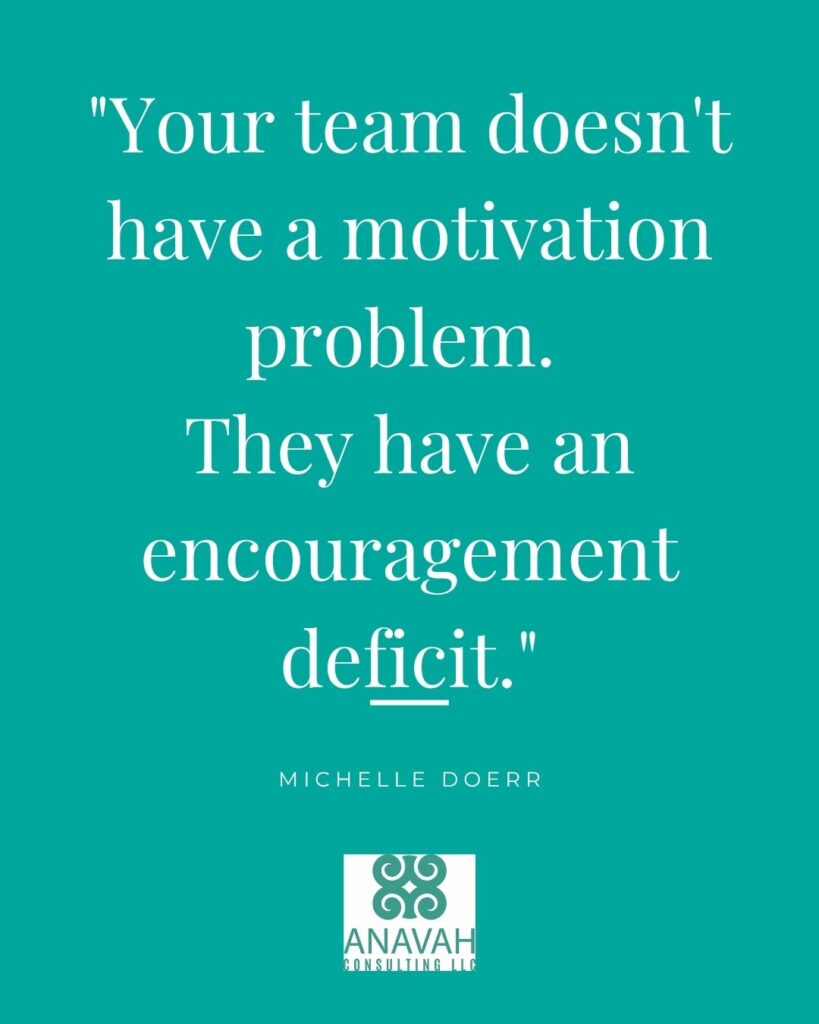
Why High-Performing Teams Still Have an Encouragement Deficit
Most leaders believe they are motivating their team. They celebrate successes in team meetings, send the “great job” email, and recognize the employee of the month. However, people are tired, disconnected, and quietly losing faith in the work.
Here’s the harsh reality: what most leaders are doing isn’t encouragement; it’s praise. And those two things are different.
We’ve built entire workplace cultures around outcomes, metrics, and performance—and we’re surprised when people feel burned out, stuck, or like their work doesn’t matter. The problem isn’t motivation. It’s a lack of genuine encouragement. And right now, in these relentlessly demanding times, that lack is costing us.
Praise Feels Like Encouragement — But It Isn’t
Praise is outcome-focused and conditional; you receive it upon success. It’s comparative: “You’re the best on the team.” It feels good in the moment, but it doesn’t create anything lasting. It actually encourages dependency: people start working for praise instead of from a genuine sense of purpose.
Encouragement is different. It emphasizes effort and courage. It builds inner confidence and promotes connection rather than comparison. The difference between “You’re the best” and “You showed persistence in the face of a really difficult problem” might seem small, but to the person receiving it, it means everything.
Alfred Adler understood this deeply. His student and colleague Rudolf Dreikurs captured it this way:
“Encouragement is the oxygen of the soul.” – Rudolf Dreikurs
Adler’s entire framework was based on the idea that human beings are driven by a need for belonging and contribution, and that encouragement connects the two. Without it, people don’t give up on work; they stop believing in themselves.
Conservation Work Makes the Encouragement Deficit Worse
Conservation and environmental efforts carry significant importance. The results are long-lasting. Progress usually moves slowly, with uncertainty, and often remains unseen. The victories are subtle, and the losses—a species, a watershed, a policy—can be devastating. Individual actions often blend into larger systems beyond anyone’s control.
When you build a culture that only values results, you often (without meaning to), tell your team that their effort doesn’t matter unless it leads to measurable success. That’s a tough message in an area where much of what truly matters can’t be easily measured. It quietly discourages trying new things, encourages perfectionism, and separates effort from value.
Your people need encouragement every single day. Not because they’re fragile, but because the work is hard, the stakes are high, and the path forward is rarely clear.
What the Data Reveals About the Encouragement Deficit
In a recent session with a state wildlife agency executive team, every single active participant took a small step toward change. When asked what happened, nearly half said it gave them momentum. Others said, “It didn’t fully work, but I learned something.” Some were still observing what happened.
That’s not a group that needed more pressure. That’s a group that needed permission to try.
When asked about the biggest obstacle to change, the response wasn’t workload. It was guilt. Guilt about setting boundaries, taking a step back, or not doing enough.
You cannot praise your way out of guilt. But you can encourage someone through it.
Broader survey data reveals the same pattern: 46% of respondents said encouragement and recognition are what they need most to feel supported. Another 44% indicated they need honest conversations about burnout and grief. These aren’t requests for more productivity tools or recognition programs; they’re requests to be seen. Encouragement remains central to it all.
How to Close the Encouragement Deficit: The HOW Behind Change
Encouragement isn’t just a mood or a management style. It’s a tool. It’s how real change happens and how people overcome discomfort, try new things, and stay committed to work that doesn’t always pay off immediately.
Think of it this way:
Encouragement = Belonging + Courage + Permission to Keep Trying
Belonging says: you matter here. Courage says: you can try. Permission says: you don’t have to be perfect.
Without encouragement, connections weaken. People might remain on the payroll, but they stop giving their best. They cease experimenting, speaking up, or caring about anything beyond getting through the day. Work is sustainable not just for individuals but also for teams facing real, constant uncertainty when encouragement is present.
Encouragement Starters: Daily Practice for Closing the Gap
Encouragement isn’t something you either have or don’t have. Instead, it’s a skill you can develop, improve, and refine over time. It all begins with paying attention.
Most effort, risk, and growth often go unnoticed in the workplace. Encouragement helps make these visible. Counselor and educator Wes Wingett, PhD, created a set of Encouragement Starters that offer a practical starting point.
- “I noticed…”
- “I appreciate…”
- “I value…”
- “I respect how you…”
- “Thank you for…”
These are acts of genuine noticing, not just pleasantries. When you say, “I noticed how you stayed with that problem even when it got messy,” you’re not complimenting someone. You’re honestly describing what courage looks like in action.
Start by auditing your own communication. Audit your emails, one-on-one conversations, and team meetings. Ask yourself: Am I emphasizing results, or am I focused on effort, courage, and contribution? Would I feel motivated if I received this message?
The Encouragement Deficit Doesn’t Fix Itself
We often talk about building resilient teams and adaptable organizations. We concentrate on strategy, systems, and structure. Yet, none of that works without a relational foundation, which includes everyday acts of recognition that show people their effort matters, their courage is visible, and their presence in the work is valued.
Encouragement isn’t soft, and it isn’t optional. It isn’t something you earn after the real work is done. It is the real work. It’s what keeps people moving through uncertainty. Encouragement makes change possible. It’s what allows connection to be more than a value on a wall.
Encouragement is how the work holds.
If this resonates with the challenges you’re facing as a supervisor or mentor, this is precisely the area covered in the Supervisor as Coach & Mentor program—helping leaders move from understanding encouragement to actually practicing it daily.
michelle@anavahconsulting.com