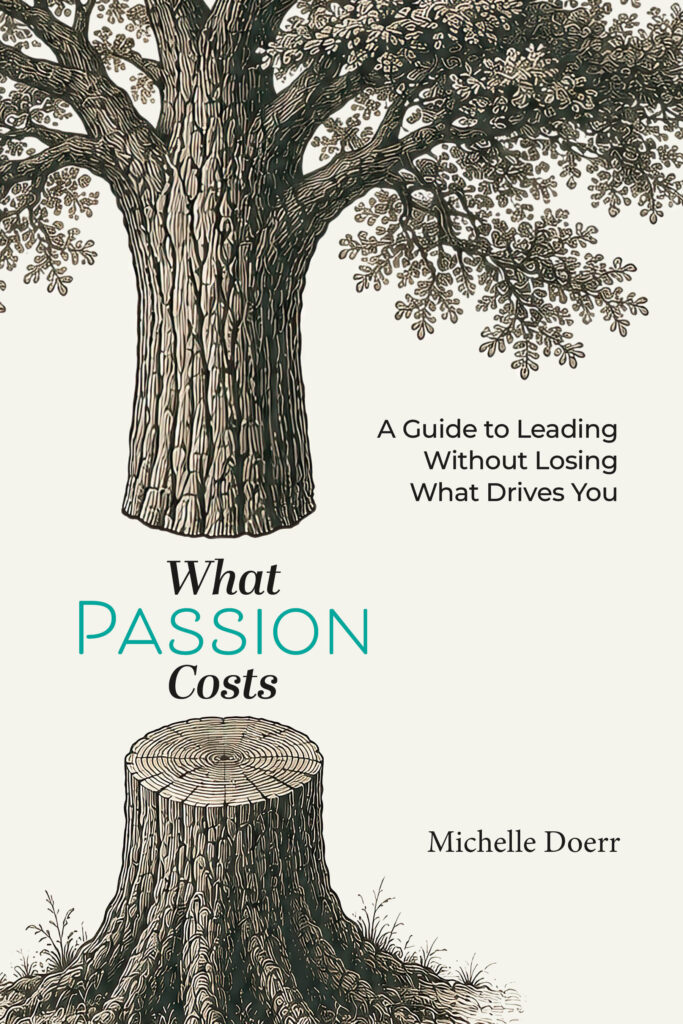
My book, What Passion Costs, explores passion extraction and what it takes to build a workplace people and the system both own, and I built it around a leadership habitats framework. Next week, I’ll be standing behind that framework at a booth at the Association of Fish and Wildlife Agencies meeting, in front of a room full of conservation leaders it was written for. As part of selling it, I wanted to test it against a different question: whether people can actually show up fully. Does the framework hold up when I apply it to myself and to conservation organizations?
What Started This Test?
This started in a Center for Purposeful Leadership Hearth conversation a few weeks back, when the group discussed the question: when can people actually show up as their full selves? And further, what has to be true for a specific person in a specific room before they stop managing themselves and start actually being present?
What Are the Six Leadership Habitats?
The six leadership habitats are Belonging, Contribution, Capacity, Voice and Power, Meaning, and Reciprocity and Stewardship, the framework What Passion Costs is built around. I know it well enough to teach it. What I hadn’t done was ask it the plain version of its own question, pointed at me. What has to be true for me to bring my whole self into a room?
I mapped the question against the six habitats and came back with this:
- Belonging: I feel welcomed and like I belong.
- Contribution: I know I have something to share.
- Capacity: I have the energy to show up, and there’s energy on the other side to receive it.
- Voice and Power: I’m clear on where power lies, and I trust it won’t be used against me.
- Meaning: I know why we’re having the conversation.
- Reciprocity and Stewardship: I know this is collective and generative, that it’s for good.
One piece sits beneath all six and deserves its own honesty. This list still assumes I can trust my own read of a room. Knowing a space is safe doesn’t help much if I can’t tell, in the moment, whether what I’m feeling is about the room or about me. That’s inner work. It’s the ground on which the six habitats stand, and it belongs in its own conversation, though it’s important to note before we go further.
How Do You Turn a Personal Leadership Habitats Test Into an Organizational Audit?
A felt condition and an organizational obligation aren’t the same claim, so each of the six leadership habitats needs a second version tailored to what a room owes, not to what a person feels. I can feel in my body that I trust this won’t be used against me. It isn’t something an organization can honestly declare about itself; time proves trust, a values statement doesn’t.
- I feel welcomed → Are we making sure everyone feels welcome and like they belong?
- I know I have something to share → Are we making sure people are sharing their expertise, talents, and gifts?
- I have the energy to show up → Do we have the capacity to receive people as they are, without requiring them to mask?
- I trust power won’t be used against me → Is it clear where power lies, and are there real checks on how it’s used?
- I know why we’re having the conversation → Are we clear about our purpose, and does what we do reflect it?
- I know this is collective → Will people receive as much as they give, and are we building something that outlasts us?
Why Is the Power Question the One Organizations Get Wrong?
In the leadership habitats framework, organizations get the power question wrong by asking whether those in power are trustworthy. No one inside can answer that question honestly, since we’re often asking the very people holding the power to judge it. What people can honestly answer is whether they can see where power sits and whether anyone checks it.
Visible means people can name, without guessing, who actually decides on budget, promotion, and project priority in a given room, and that this matches who the organization says decides. Checked means there’s a real path to question or appeal a decision that doesn’t run through the person who made it, and people actually use that path without it costing them. A staff meeting where anyone can ask “who signed off on this” and get a straight answer is visibility. A grievance process nobody has ever successfully used isn’t a check; it’s a formality. Visibility and checks are the things you can actually build and point to.
Why Is Capacity the Condition Most Often Misdiagnosed?
Of the six leadership habitats, organizations most often misdiagnose capacity because they ask whether people have the energy to show up, when what actually erodes belonging isn’t low energy. It’s masking.
A prairie makes this easier to see than an org chart. Stop mowing a former prairie, and it will green up fast, but green isn’t the same as recovered. Without the right fire interval, an intact seed bank, and years of the right kind of disturbance, what comes back resembles a prairie without being one. An organization that can’t tell the difference between someone contributing and someone performing themselves into safety has the same problem. It’s reading the wrong signal for recovery.
What Happens When These Leadership Habitats Don’t Hold?
When these habitats don’t hold, people stop bringing their real input into the room long before anyone notices they’ve gone quiet. I’ve watched this happen within conservation leadership culture. A few years ago, some young natural resources professionals joined a committee I’d been on for a while. You could watch them running the audit in real time, testing, in small ways, whether their voices were actually welcome or whether the room just technically allowed them to speak.
Some of the habitats held. Belonging mostly did; people said hello and made room at the table. Voice and Power didn’t. It was never clear where the real power in that room sat, or whether raising a concern would cost you later. So they stayed quiet in the moments that mattered, and the room never gained their perspective. This is a system that hadn’t done the work its invitation implied.
What’s the Real Test at My Own Booth?
The real test at my booth isn’t whether I sell books; it’s whether the exchange itself passes the same six-question audit I ask everyone else to run. It would be easy to hand someone a book about ownership and let the transaction end there. The harder, truer thing is to ask whether anyone at that table had the chance to bring their actual condition, their agency, their crew, or their committee into the conversation.
What would your six conditions be? If you ran your organization through the same audit, which question would be hardest to answer honestly?
If you want the fuller map behind these six conditions, that’s what What Passion Costs does. Find it at Amazon or Bookshop. And if you want to run this audit directly within your own agency, team, or organization, that’s the work I do in consulting. Reach out HERE.
Michelle