
How conservation leadership culture silences the experiences that sustain it
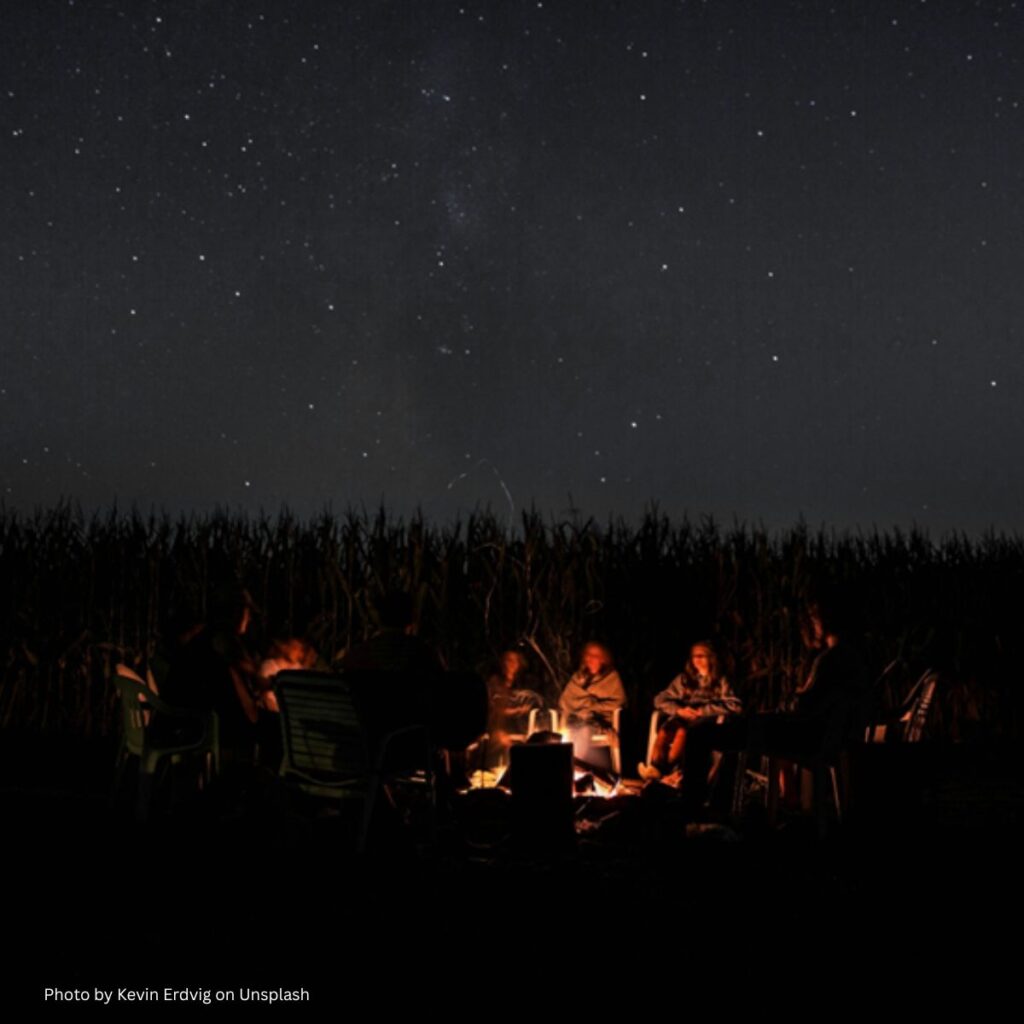
Picture a campfire.
Not as metaphor yet. Just the thing itself.
Imagine a circle. Everyone is equally distant from the center, with no head of the table, no podium, and no raised platform. Warmth is physical and shared. The darkness at the edges surrounds the circle rather than exposing it. No technology mediates your connection to each other. The pace slows naturally without anyone deciding it should.
Something happens around a campfire that rarely occurs in a conference room. People speak honest truths. They ask questions they don’t have answers for. They sit with uncertainty without feeling the need to fix it. Sometimes, with surprise, they realize they actually like each other.
Now picture that campfire getting policed.
Someone decides the questions being asked are too personal, too uncertain, or too unproductive. The circle gets replaced with rows. The questions get replaced with agenda items. The darkness gets replaced with fluorescent light and someone’s PowerPoint.
That is not a hypothetical. It is what actually happened when conservation professionals within the U.S. Fish and Wildlife Service found a space to discuss grief, found it meaningful, and watched it get shut down.
The campfire got canceled, and something important went underground.
It’s a small story about a big problem: conservation leadership culture still doesn’t know how to make sanctuary for the people doing its most important work.
We Entered Through Transcendence
Here is the absurdity, stated plainly.
Most people in conservation entered through something that happened to them outdoors — a morning on a river, a first encounter with something wild and indifferent to human concerns, or a moment when the world seemed to reorganize itself around something bigger than just a career or credentials. These experiences can’t be reduced to data.
That experience, which is personal and irreproducible in a laboratory, is what filled the pipeline. It is what drew people toward decades of difficult, underpaid and emotionally costly work.
The data confirms this. In workshops I have led with conservation professionals over the years, I’ve asked participants if they experience a sense of transcendence when in contact with nature. In one group, 88 percent strongly agreed, with the remaining 13 percent somewhat agreeing. In another, 58 percent strongly agreed and 33 percent somewhat agreed. Overall, the experience was nearly universal. Almost everyone in the room, by their own account, has felt what can only be described as transcendence in nature.
And then they walked through the professional door and quickly learned, without anyone saying so directly, that the experience didn’t matter. The field was recruited from transcendence and then institutionally silenced.
Ecogrief, the grief that arises from witnessing environmental loss, is not a personal failing. It is a relational signal. And in a field where nearly everyone reports transcendence in nature, its absence from professional culture is not incidental. It is structural.
I’m sure it wasn’t done maliciously, but it happens almost automatically. This is due to the accumulated influence of a professional culture that inherited Western science’s specific deal: valuing objectivity in exchange for credibility, measurable results for legitimacy, and separating the knower from the known to gain a seat at the policy table.
It was a bargain with real value. But it had a cost that rarely gets named.
And it’s important to note that this bargain was never universal. Indigenous science has always valued relationships, reciprocity, and belonging as legitimate forms of knowledge. Eastern traditions incorporate interior experience as data. Many conservation practitioners, especially those from non-Western backgrounds, bring ways of knowing the living world that the dominant professional culture cannot fully accept because it has already decided what counts as real. The person who grew up fishing with their grandmother and knows that river in their bones is asked to translate that knowledge into something a grant proposal can accommodate. And something is lost in that translation every time, not just personally but epistemologically. The field narrows what it can know when it only trusts one way of knowing.
What We Learned Not to Say
The science-spirituality binary is one enforcement mechanism. However, it is not the only one, and conservation professionals describe its effects with remarkable consistency.
In the same workshops where almost everyone raised their hand for transcendence, I’ve asked participants why it’s so hard to talk about these experiences professionally. The answers come quickly, and they sound like this:
“Field is science-based and quantitative and resists subjective. How do we leave space to honor?”
“My own story — I’ll be judged. Don’t talk about politics and religion, even though spirituality is embedded.”
“We talk economics and science, but not about what is truly important.”
“The spiritual tools, in addition to science tools, would probably make our work easier.”
This is the architecture of silence: not a formal ban, but an internalized self-censorship. People understand the culture’s preferences and adjust accordingly. They express their core reasons for doing the work in a way the institution understands, and they leave the rest unspoken.
And it is not only transcendence that gets silenced. Grief doesn’t belong because it signals weakness, or worse, unsustainability. Uncertainty doesn’t belong because it signals incompetence. The biologist who weeps while driving past a wetland they spent twenty years restoring, now drained, has no professional outlet for that loss. The young professional who quietly admits they got into this work because standing in old growth felt like standing in something sacred is met with a change of subject and a slightly uncomfortable silence.
The system doesn’t explicitly announce this policy. It enforces it through subtler cues: the raised eyebrow, the strategic shift in subject, the conference agenda filled with presentations and no pauses, and a culture that values composure over honesty.
The result is a specific kind of estrangement. Not necessarily from the work itself, but from the meaning behind it. Also, from the initial encounter and why any of this mattered.
When meaning becomes inaccessible, what remains is the performance of commitment: showing up, executing, and producing without the source that made it sustainable. That is what systems produce when they structurally deny sanctuary.
A recent survey of 61 conservation professionals highlights this experience: 57 percent reported feeling both overwhelmed and burned out at the same time. Only 1 in 5 felt motivated and energized. Meanwhile, 30 percent reported feeling disconnected from work they once loved. These are not people who lost their passion; these are people whose systems gave them no space to express it.
What the Waiting Lists Knew
Between 2021 and 2023, I co-facilitated a series of workshops for U.S. Fish and Wildlife Service employees titled “Acknowledging Ecogrief and Developing Resilience.” Every session was full, with several having waiting lists.
That is not a story about fragile employees, but a signal. People were hungry for a container for something they had been carrying alone. They found one, and they came.
This hunger was not limited to those sessions. When conservation professionals were surveyed about their main needs for professional development, 53 percent identified open and honest discussions about difficult issues as their top priority, even before skills, tools, or anything else. They wanted permission to be truthful. Sixty-eight percent preferred peer circles and small group conversations over formal training sessions. Fifty-seven percent sought ongoing support rather than one-time workshops. In survey language, what they described was a sanctuary.
Taken together, the data describes a workforce asking not for skills or programs, but for permission. They need permission to be honest about what the work costs and what it means.
What they said inside those workshops tells you something that survey data cannot:
“My feelings are allowed and it’s okay to sit with them.”
“Emotions have a place in science.”
“We are not alone in our grief. We don’t need to be alone in our resilience.”
One participant shared something that has stayed with me: “Don’t know how to talk with young people entering the conservation field about this, because I want them to feel hopeful, but that isn’t what I feel.”
These are not radical statements. They are basic human permissions. The fact that people were writing them down as takeaways, in a professional development session at a federal agency, shows what the rest of their professional lives felt like.
The workshops were canceled due to political intervention by Congressional oversight. No cultural argument was necessary; the power was enough. It is a clean illustration that sanctuary within federal agencies depends on the political convenience of those who find emotional honesty uncomfortable. The people who most needed a safe space for their feelings had it taken away by individuals who apparently decided that conservation workers processing grief was somehow a problem to be fixed.
Conservation Leadership Sanctuary Is Not a Wellness Concept
It is worth being clear about what sanctuary actually is, because the word can easily be softened into something less than what it actually means.
In conservation leadership, sanctuary means intentionally creating conditions where people can bring their full experience to work. This includes grief, uncertainty, transcendence, and the deeper meaning beneath their role.
Sanctuary is not about comfort. It doesn’t mean the absence of difficulty or that no one will face challenges. Instead, it resembles a protected wildness where something too fragile or new to survive openly can begin to unfold. It’s the environment that makes genuine encounters possible; a place where people aren’t performing roles, managing impressions, or protecting their certainties.
Some of you have sat in a gathering not focused on solving problems but on discovering what emerges when people ask genuine questions together. In those settings, questions don’t come with fixed answers; instead, they see uncertainty as a starting point rather than an obstacle. In those spaces — like a Hearth conversation or a circle with a question and enough time — something different becomes possible. Insight comes from the conversation itself, not from the expert at the front. People say things that even surprise themselves. Connections form between ideas and between people that no agenda could have created.
That is sanctuary in practice. And it doesn’t require a budget line, an offsite, or a consultant. It demands a leader willing to ask a different kind of question and stay genuinely curious about what comes back.
We already know how to do this through the campfire. That knowledge is older than the institution. The question is whether we’re willing to bring it inside, not as a program, but as a different understanding of what gathering is for.
What You Can Do With the Authority You Have
This section is for a specific person: the one who has enough scar tissue to have stopped blaming themselves for systemic conditions, and enough authority to begin experimenting with the room they are responsible for. The mid-career or senior leader who knows the culture from the inside, has felt what it costs, and is seeking something more than just another framework.
You can’t dismantle the institution, but you can change what happens in the room you’re responsible for. These aren’t programs; they’re experiments — small, low-risk shifts in conditions that open up different possibilities.
- Protect the source — yours and theirs. The loss of connection to meaning happens gradually and structurally. Fight against it intentionally. The initial encounter with wildness that brought you into this work is not optional; it is essential. Nurture it deliberately or your work will slowly drain it. Identify, honor, and safeguard the practice of reconnecting with what drew you in. Allocate time for it. Explain to your team why. “I walk Tuesday mornings. I think you should find your version.” That isn’t self-care language. That’s about maintaining your core and it IS professional.
- Change how you gather. What if one meeting a month had no agenda items, just a question and a circle? What if a team gathering included time outside, without goals? What if you opened a staff meeting by asking “what are you carrying in today?” and actually waited for the answer? The way we gather shapes what becomes possible; not because people change, but because conditions do.
- Name the grief. The field is filled with people carrying losses that lack a container: degraded places, vanished species, and work that failed. You don’t need a program to recognize this. You need a moment of intentional naming. “We’ve lost something here, and I want to say that before we move on.” That sentence takes fifteen seconds and sets conditions that nothing else can.
- Ask questions that don’t have answers. Not every gathering needs to result in a decision. Some of the most meaningful moments between people happen during genuine inquiry, when the leader doesn’t already know the answer and everyone in the room is aware of it. This isn’t a facilitation technique. It’s a sign of respect for the complexity of the work and the intelligence of those involved.
- Say the word. Simply naming what you are trying to create — “I want this to be a space where we can be honest” — changes conditions without requiring a policy. Language creates permission. Permission creates possibility.
What Becomes Possible
You entered this field through something. You might not have called it transcendence, awe, or sanctuary, but you know what it was. You can feel it when you try to remember.
The question isn’t whether that experience was real. It was, and the numbers confirm it. The real question is what we’ve built that makes it so difficult to accept internally, and whether the senior version of you, with all your authority and scars, might be the perfect person to start changing that.
One participant in those ecogrief workshops shared this as their takeaway: “grateful that the Service is encouraging more self care and forums like these to share our feelings so we don’t have to split our heart and head.”
That was written before the cancellation.
What the field needs isn’t just another program. It needs leaders who are willing to stop expecting people to split their heart and head at the door. Leaders who ask what becomes possible when the whole person shows up — not just the credentialed, composed, productive self, but the one who entered through transcendence and still carries that initial encounter somewhere underneath the role.
The campfire didn’t go anywhere. It’s waiting.
One circle at a time.
Feel free to contact Michelle at michelle@anavahconsulting.com